The Battle of the Brands

A brand war is what happens when two competing brands in the same market develop a direct rivalry. The prize? Your attention and some rather funny advertising. Earning a consumer’s attention is difficult enough on its own. Doing it while a rival is trying to do the same is harder still, because that consumer may already have money and emotion invested in the other guy. This has produced some iconic rivalries over the decades. Let’s start with the one you’ve almost certainly heard of: Coca-Cola vs. Pepsi.
The Cola Wars are arguably the greatest brand rivalry in marketing history. Coca-Cola, founded in 1886, and Pepsi (introduced as Brad’s Drink in 1893 and renamed Pepsi-Cola in 1898) have competed for well over a century. Coca-Cola had a decade’s head start and used it to become the market leader; Pepsi spent much of its early history playing catch-up. By the 1960s and 1970s, Pepsi had turned itself into a genuine challenger with youth-focused marketing and the Pepsi Challenge, which named Coca-Cola directly
The Pepsi Challenge was a series of blind taste tests in which participants often chose Pepsi. Of course the
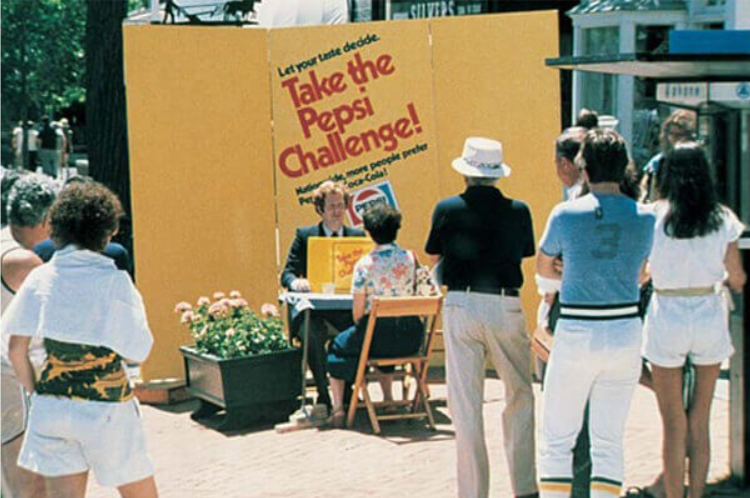
Ads only showed the results Pepsi wanted you to see. Marketing campaigns rarely lead the people who preferred the other guy. Why let an inconvenient truth get in the way of a good campaign? Those ads put real pressure on its larger rival. Coca-Cola’s response was one of the biggest marketing gambles ever: New Coke in 1985, a sweeter formula designed to taste more like Pepsi. That big gamble proved to be a big fumble when consumers overwhelmingly rejected it. Turns out, people who drank Coca-Cola preferred the taste of Coca-Cola. Who knew? Within months the company brought back the original as Coca-Cola Classic and turned an expensive fumble into a loyalty-building PR win.
The advertising battle didn’t stop there. Pepsi became known for cheeky spots that poked at Coca-Cola. Kids using Coke cans as stepping stools to reach a Pepsi machine. It also launched social campaigns implying Pepsi was the cooler, more modern choice. Coca-Cola generally stayed less confrontational, relying on iconic branding and emotional storytelling, though it occasionally fired back. The rivalry continues even today, proving that sometimes competition itself becomes part of a brand's identity.
Soft drinks aren’t the only place corporate heavyweights throw hands. Fast food has its own long-running beef: McDonald’s versus Burger King. McDonald’s began as a single California burger stand in the 1940s and exploded under Ray Kroc’s franchise machine, built on speed, consistency, and the Golden Arches. Burger King arrived later in 1953 as Insta-Burger King and spent decades positioning itself as the rebellious alternative. Where McDonald’s promised the same burger every time, Burger King leaned into customization with “Have It Your Way.” The message was simple and slightly snarky: we make the burger you actually want.
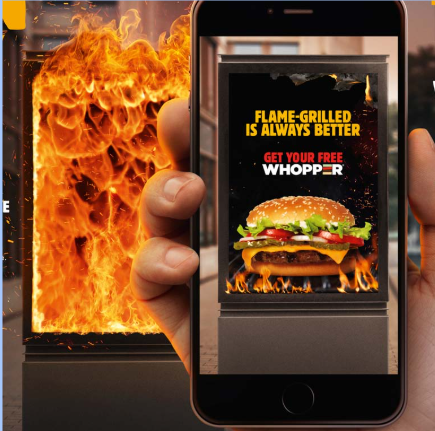
The ads got personal. Burger King has a long history of needling the bigger chain. Spots that mocked the Big Mac, the “Burn That Ad” AR campaign that let people torch McDonald’s ads for a free Whopper, and the Whopper Detour, which offered a one-cent Whopper if you were within 600 feet of a McDonald’s and ordered through the Burger King app. McDonald’s has usually preferred to stay above the fray. Burger King was not above name-calling, with one hiring ad that read “Work for a King, not a Clown.” What did poor Ronald McDonald ever do? Still, the rivalry forced both sides to innovate. Menu experiments, value meals, and late-night offerings often appear first as competitive responses before becoming industry norms. The customer wins: more options, lower prices, and the occasional highly entertaining commercial.
Then there’s the one with a clear winner.Nwinner.intendo versus Sega is the rare brand war that actually ended. After the 1983 video-game crash nearly killed the industry in North America, Nintendo’s NES revived it and then owned it. By the late 1980s the company had the living-room console market in a headlock: family-friendly, tightly controlled, and built around Mario. Sega, tired of being the afterthought, launched the Genesis in North America in 1989 and decided politeness was for losers. Sonic the Hedgehog arrived in 1991 as a direct response to Mario: faster, cooler, and designed to make Nintendo look like it was still making toys for children. The slogan “Genesis does what Nintendon’t” is about as subtle as a brick through a window, which also accurately summarized Sega’s marketing strategy. The ads were openly contemptuous. Sega treated Nintendo the way Pepsi treated Coke.
The technical bragging got even dumber. Sega spent a small fortune insisting the Genesis had something called Blast Processing, which the Super Nintendo supposedly lacked. One of the most famous ads opened by announcing that the Genesis had it and the Super Nintendo didn’t, then asked what Blast Processing even does. Cue a TV strapped to a drag racer tearing down the road while Sonic, Ecco, and Streets of Rage footage flew by. Then the narrator asked what happens if you don’t have it, and the camera found a sad old van sputtering along with Super Mario Kart on the back.
It was mostly marketing hype. There was a real, extremely niche hardware trick involving blasting data to the video chip mid-scanline, theoretically good for extra colors on still images. It was a pain to use, unreliable across hardware revisions, and never actually appeared in any commercial games. The phrase just sounded fast and violent, so the ad people ran with it.
Ultimately Sega lost the hardware race. It fumbled the Saturn, overreached with add-ons, and watched the Dreamcast get crushed by Sony’s PlayStation 2. In January 2001 Sega announced it was leaving the hardware business. Nintendo is still selling consoles. Sega now makes games for other companies’ machines. Including those of its once-greatest rival.
Brand wars are rarely just about the product. They are about who gets to define the category, who owns the cultural moment, and who the customer wants to be seen choosing. Coca-Cola and Pepsi turned a taste-test stunt into a century-long identity contest. McDonald’s and Burger King turned burgers into a running argument about consistency versus personality. Nintendo and Sega turned living-room consoles into a personality clash so fierce that one company eventually left the hardware business entirely.
The winners are not always the ones who shout loudest. Sometimes the challenger forces the leader to change; sometimes the leader simply outlasts the challenger. In every case the fight itself becomes part of the brand. Customers remember the ads, the slogans, the petty jabs, and the occasional spectacular own-goal. They also get better products, lower prices, and a show. That is the real prize of a brand war: not just market share, but a story people keep telling long after the commercials stop running.



Comments